The hidden multiplier in pathogen recalls
When the FDA, CDC or USDA announces an outbreak linked to Salmonella, whether in spices, flour, produce, dairy powders or nut butters, the announcement is the start of the work for every manufacturer that bought the implicated ingredient, not the end of it.
The question each of them has to answer is narrow and urgent: which of our finished lots contain the affected ingredient lot, and where did they go? Answer it precisely and the recall covers the product that is actually at risk. Answer it slowly or loosely and there are two bad outcomes. Either affected product stays on shelves while you search, or you recall everything made in the period to be safe, destroying good inventory because you cannot prove where the affected lot stopped.
How one ingredient becomes thousands of products
The 2008 to 2009 outbreak linked to peanut products from the Peanut Corporation of America shows the pattern at its most extreme. The contaminated ingredient was not mainly sold to consumers. It was sold to other manufacturers as peanut paste and peanut butter, and they used it in crackers, cookies, snack bars, ice cream and pet food. The CDC linked more than 700 illnesses and nine deaths to the outbreak, and the recall eventually covered thousands of products from hundreds of companies.
For a batch manufacturer the lesson is structural. An ingredient does not stay in one product. It moves through a plant in predictable ways.
1. One ingredient lot, many batches
A 1,000 kg tote of spice or flour is rarely used in a single batch. Split across eight production runs, one supplier lot becomes eight finished lots, often across several products and pack sizes.
2. Rework spreads it further
If any of those batches produce off-spec product that is reworked into later batches, the ingredient reaches lots made days or weeks after the original, from entirely different raw materials. Unless rework is recorded as an input, a trace starting from the ingredient will not find them.
3. Shared equipment
Salmonella can survive for long periods in dry, low-moisture environments, including on equipment, in dust collection systems and in the building itself. Product made on the same line after a contaminated batch can be at risk even if it never contained the ingredient. That is why cleaning and line clearance records matter to a recall as much as ingredient records do.
4. Distribution is fast
Finished product can reach many customers and distribution centers within days of being made. By the time an ingredient is implicated, much of what was made from it has usually shipped, so the value of a trace depends on how quickly it produces an accurate customer list.
Forward and backward tracing
Containment relies on two traces, usually run together.
Backward trace: where did it come from? Starting from a finished lot, identify every ingredient lot used to make it, the supplier and receiving record for each, and any rework it contained. You need this when a complaint or a positive test result starts at your finished product.
Forward trace: where did it go? Starting from an ingredient lot, identify every batch that used it, every finished lot those batches produced, including through rework, and every customer and shipment that received those lots. You need this when a supplier or a regulator tells you an ingredient is implicated.
One useful way to judge how well a recall was contained is precision: the share of recalled product that actually contained the affected lot.
Recall precision = product that contained the affected lot divided by total product recalled
A plant with precise lot records recalls close to 100% affected product. A plant without them may recall several times the affected quantity, simply because it cannot draw the line.
The first hours after an ingredient is implicated
A supplier notice or an FDA announcement usually names a product and a set of lot codes or a date range. What happens next decides both the size of the recall and how long affected product stays on the market:
- Confirm exactly which lots are implicated. Match the supplier's lot codes against your receiving records, including deliveries booked under a different product description or split across more than one warehouse.
- Put every matching lot on hold immediately, including stock already staged at a line or partly used.
- Run the forward trace from each implicated lot to every batch, finished lot and rework stream that consumed it.
- Separate what you still hold from what has shipped. Stock on hand can be held and assessed. Shipped product needs a customer list with quantities and delivery dates.
- Give each affected customer specifics: the finished lot codes, quantities and delivery dates for their account, rather than a blanket notice that forces them to search their own stock.
- Keep the trace as a record. The same output answers your regulator, your customers and, later, the root cause investigation.
Every one of these steps is a query against your lot records. When those records are connected, the whole sequence can be completed within the first working day.
What slows a trace down
When recalls go badly, it is rarely because records are missing altogether. It is because they cannot be joined quickly:
- Receiving logs record supplier lot numbers, but batch sheets record only internal codes.
- Batch sheets record which ingredients were used, but not which lots, or not how much of each.
- Partly used containers are not tracked, so a second batch that finishes a tote is invisible.
- Shipping records identify the customer and date, but not the lot that was shipped.
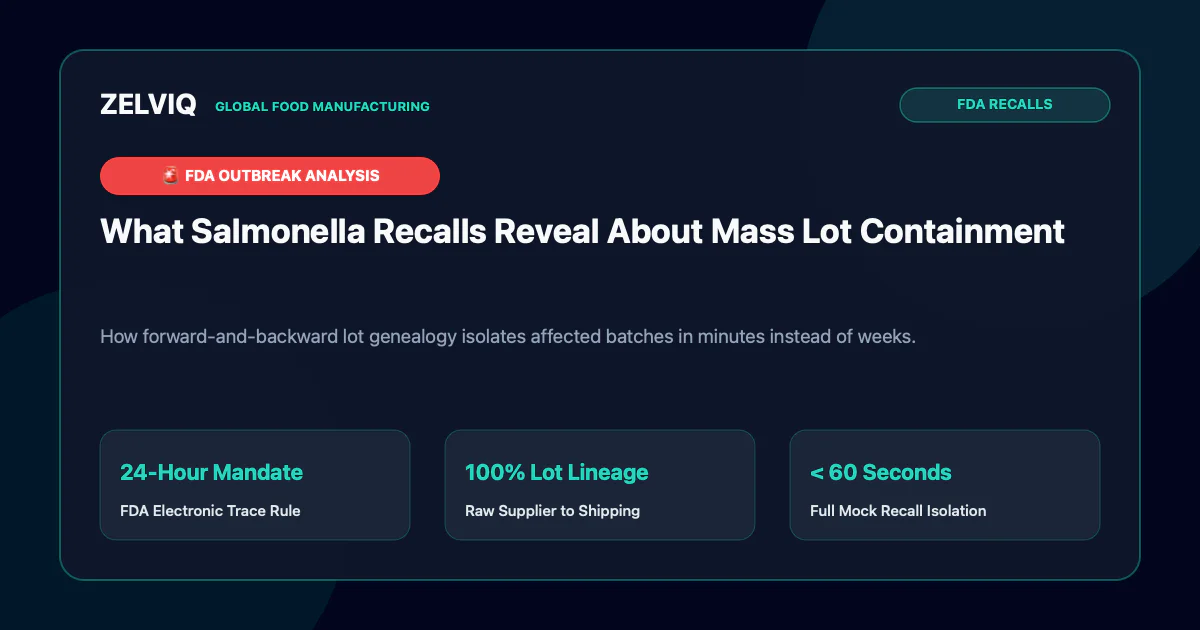
Each gap turns a database query into a manual investigation. The FDA's Food Traceability Rule, whose compliance date is July 2028 for foods on its list, requires records that can be produced within 24 hours for exactly this reason.
Controls that make containment fast
The plants that contain recalls well share a handful of practices:
- Quarantine by lot, everywhere at once. When an ingredient lot is implicated, it goes on hold in every location, so nobody can stage it into another batch while the investigation runs.
- Block quarantined lots at the point of use. Production cannot consume a lot that is on hold, so the containment holds even on a busy night shift.
- Record consumption and rework against the batch. Every input lot and quantity, including rework and partly used containers, is part of the batch record.
- Ship by lot. Every shipment records which lots it contained, so the forward trace ends in a customer list rather than an estimate.
- Practice. A timed mock recall run against a real lot shows where the trace breaks before a real recall does.
With these in place, the answer to "which lots, and where did they go?" takes minutes, and the recall covers the product at risk rather than everything made that month.
Found this article valuable?
Share it with your operational team and industry peers.