The margin leak hiding in plain sight
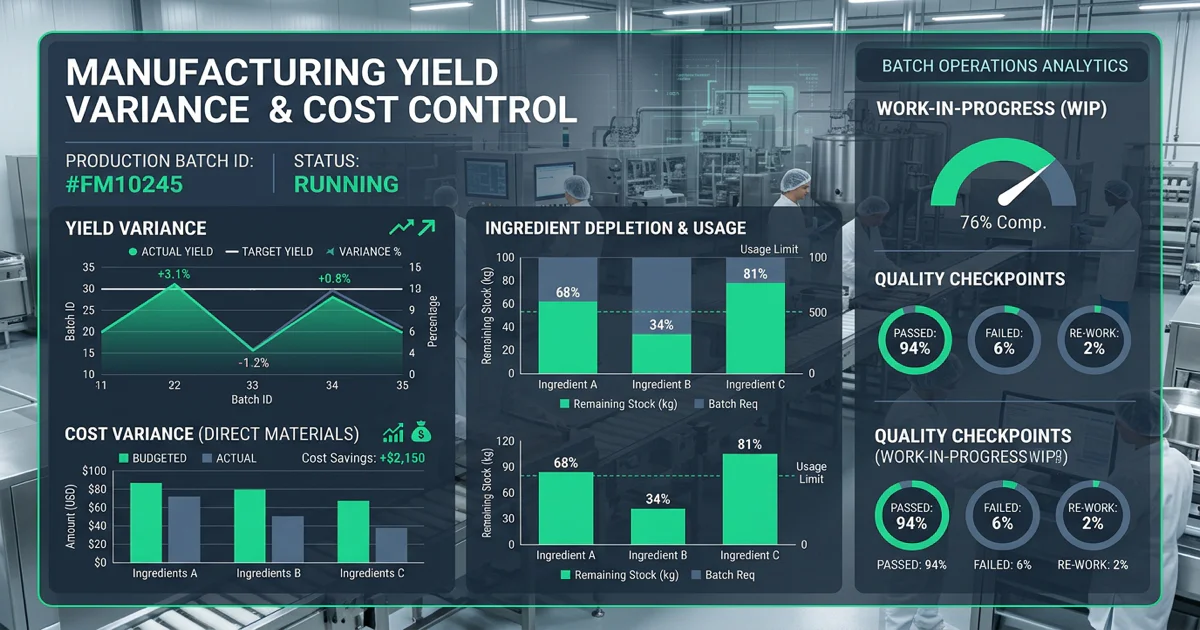
In batch manufacturing, whether brewing craft beverages, formulating supplements or producing baked goods, a large share of the difference between a good year and a bad one is yield variance: the gap between the output a formula says you should get and the output you actually get.
Most operations cost their products with a standard bill of materials, which assumes a recipe of known inputs produces a known quantity of finished goods. When reality drifts from that assumption, standard costing does not show the loss. It keeps reporting the standard cost, inventory records keep showing material that has physically gone, and the difference surfaces months later as an unexplained write-off at the stock count.
How to calculate yield and yield variance
Three numbers matter for every batch:
- Theoretical yield: what the formula should produce from the inputs actually used.
- Actual yield: what the batch produced, in saleable units or weight.
- Yield percentage: actual yield divided by theoretical yield, multiplied by 100.
A worked example. A sauce formula uses 1,000 kg of ingredients and is expected to produce 900 kg, because the recipe already allows 100 kg for evaporation during cooking. This batch produces 855 kg.
- Yield percentage: 855 divided by 900 = 95%
- Yield variance: 900 minus 855 = 45 kg, or 5% of expected output
The cost effect is larger than the percentage suggests. If the ingredients cost $2,700, the standard cost is $3.00 per kg of sauce (2,700 divided by 900). The real cost of this batch is $3.16 per kg (2,700 divided by 855). Every kilogram sold carries about 5.3% more material cost than the costing system believes.
The error grows quickly when the loss is not modeled at all. If a costing system assumes 1,000 kg in means 1,000 kg out, and the batch actually yields 820 kg, the true cost per kilogram is not 18% higher than reported. It is 22% higher (1,000 divided by 820), because the same cost is spread over fewer kilograms. Treating a loss percentage as a cost percentage understates the damage every time.
Where the missing material goes
Yield loss rarely comes from one dramatic event. It accumulates across small, routine losses.
1. Moisture loss and process shrink
Cooking, baking, drying and pasteurization all remove water. That loss is real and predictable, and it belongs in the formula's expected yield. The problem starts when the expected yield was set once, years ago, and never checked against what the process does now.
2. Giveaway at filling
Net quantity rules in both the US and the UK require packs to meet their declared quantity on average, with limits on how far any single pack may fall short. Filling lines are therefore set to run slightly over. A small average overfill is sensible. Left unmeasured, it becomes one of the largest and least visible losses in a plant, because it leaves the building inside the customer's product rather than in a waste bin.
3. Line losses, heels and flushes
Product left in pipes, hoppers and tank bottoms, material lost at startup and changeover, and product flushed out during cleaning between allergen or product transitions all reduce yield. Each batch loses a little, and none of it is recorded unless someone weighs it.
4. Rework without lineage
Feeding off-spec product back into later batches recovers material, which is good. But if the rework is not recorded as an input, the later batch shows an impossibly high yield and the earlier one an impossibly low one. Both numbers become useless, and so does the traceability record.
5. Recording errors
Sometimes the material was never lost. A scale that has drifted, a quantity keyed in the wrong unit, or a partly used container booked as full makes the variance look like waste when it is really bad data. It is worth ruling this out first, because it is the cheapest cause to fix.
Mass balance: what auditors actually check
A mass balance, or quantity reconciliation, checks that everything that came in is accounted for by what went out:
Input used = finished product + documented waste and losses + stock remaining
In a traceability exercise, you choose a raw material lot and show that every kilogram received can be accounted for in finished product, waste, or stock still on hand.
Two points are often misunderstood.
Where it is required. The BRCGS Global Standard for Food Safety requires traceability tests to include a quantity check or mass balance, and expects full traceability to be achievable within four hours. In the US, the FDA's food cGMP rule (21 CFR Part 117) does not prescribe a mass balance. The dietary supplement cGMP rule (21 CFR Part 111) goes further: the master manufacturing record must state the theoretical yield at each stage, with the percentages beyond which a batch must be investigated.
What a good result looks like. No standard sets a universal pass mark. Your site should set its own tolerance for each product, based on the losses you can explain, and investigate anything outside it. An auditor is looking for a result you can explain, not a particular number.
From monthly reconciliation to batch-level control
Most plants discover yield problems at month end, when the variance is a single figure spread across hundreds of batches and the cause is impossible to find. The operations that control yield well measure it per batch and review it in groups:
- Weigh what goes in. Connecting scales to the batch record captures the actual quantity of each input lot, not the recipe quantity.
- Record what comes out, and what is lost. Finished output, waste, samples and rework are recorded against the batch, so the mass balance closes without guesswork.
- Set tolerances on the materials that matter. A tight tolerance on an expensive active ingredient catches a scaling error while the batch is still in progress, not three weeks later.
- Group the variance. Sorting yield by product, supplier lot, shift and line usually makes the cause obvious. If yield drops only on batches made from one supplier's material, that is a purchasing conversation. If it drops on one shift, it is a training conversation.
- Cost from actual yield. When product cost uses each batch's actual yield, margin reports show the loss where it happened instead of in a year-end write-off.
When yield, lot usage and cost sit in the same record, variance stops being a mystery number and becomes a short list of specific batches worth investigating.
Found this article valuable?
Share it with your operational team and industry peers.