What FSMA 204 actually changes
The FDA's Food Traceability Rule, issued under Section 204 of the Food Safety Modernization Act and codified at 21 CFR Part 1, Subpart S, applies to anyone who manufactures, processes, packs or holds foods on the Food Traceability List (FTL). The list includes leafy greens, fresh-cut fruits and vegetables, shell eggs, nut butters, fresh herbs, cheeses other than hard cheeses, finfish, crustaceans, molluscan shellfish and ready-to-eat deli salads, among others.
The rule does not ask whether you keep records. It asks whether you can hand the FDA a complete, connected account of where a lot came from and where it went, and do it quickly. When the FDA requests traceability records, you must provide them within 24 hours, or within a longer period the agency agrees to. During an outbreak, a recall or another threat to public health, the FDA can also require them as an electronic, sortable spreadsheet.
The compliance date. The final rule was published in November 2022 with a compliance date of January 20, 2026. The FDA has since extended that date by 30 months, to July 20, 2028. The requirements did not change. The extension is best read as time to build the system properly rather than a reason to wait, because customers and auditors are already asking suppliers for this level of traceability.
Critical Tracking Events and Key Data Elements
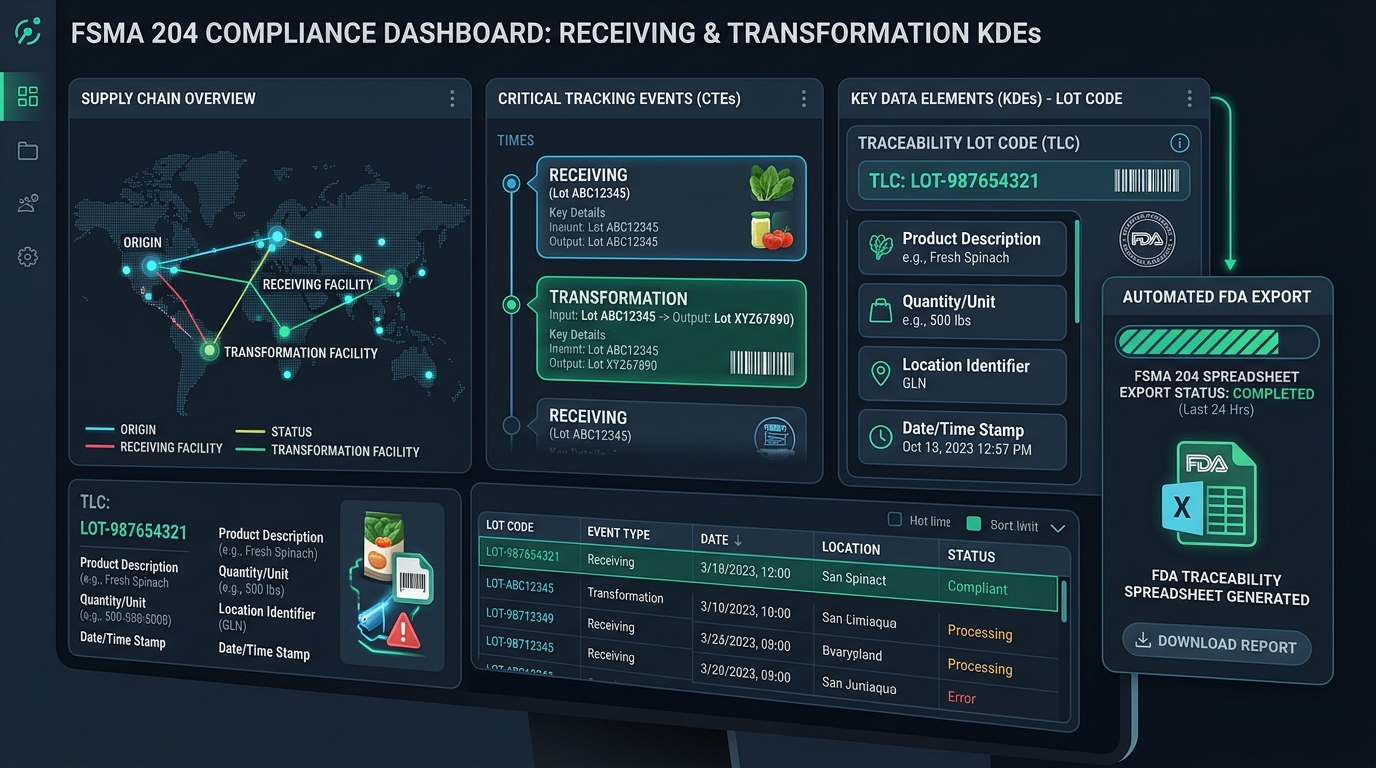
The rule rests on two ideas. A Critical Tracking Event (CTE) is a point where a food changes hands or changes form: harvesting, cooling, initial packing, first land-based receiving of seafood, shipping, receiving and transformation. At each event you record specific Key Data Elements (KDEs).
For a manufacturer or processor, three events cover almost everything you do: receiving, transformation and shipping.
Everything connects through the Traceability Lot Code (TLC), the identifier assigned when a food is initially packed, first received on land from a fishing vessel, or transformed. The TLC and the place it was assigned, called the TLC source, travel with the food through every later record.
Receiving
When an FTL food arrives, record:
| Key Data Element | In practice |
|---|---|
| Traceability Lot Code | The supplier's TLC, recorded exactly as received |
| Quantity and unit of measure | For example, 40 cases or 1,200 kg |
| Product description | Enough to identify the food |
| Immediate previous source | The business that shipped it to you |
| Receiving location | Where you received it |
| Date received | The day it arrived |
| TLC source | Where the TLC was assigned, or a reference the FDA can use to find it |
| Reference document | Its type and number, such as a bill of lading or invoice |
The most important rule at receiving is also the one most often broken: you keep the supplier's TLC. A receiver does not assign a new TLC unless it transforms the food. Many internal lot-numbering schemes quietly replace the supplier code at the dock, which cuts the chain before production has even started.
Transformation
Transformation is any process that changes a food or its packaging: cooking, blending, cutting, mixing or repacking. It is where most traces break, because several input lots become one new lot.
For each input, record the TLC, product description, and quantity and unit of measure of every FTL food used. For the new food, record the new TLC you assign, where the transformation happened (this becomes the TLC source), the date it was completed, the product description, the quantity produced, and a reference document such as the work order or batch record.
The hard part is not recording the new lot. It is recording exactly which input lots went into it, and how much of each. A batch made from five totes of one ingredient that came from three supplier lots has to show all three.
Shipping
When you ship an FTL food, record the TLC, quantity and unit of measure, product description, the immediate subsequent recipient, the location you shipped from, the date shipped, the TLC source and the reference document. You must also pass the TLC and TLC source information to your customer, so the chain continues after the food leaves your building.
The written traceability plan
Alongside the event records, the rule requires a written traceability plan. It must describe how you maintain the required records and in what format, how you identify the FTL foods you handle, how you assign traceability lot codes, and who to contact with questions about the plan. Farms must also include a farm map. The plan must be kept current as your practices change, and traceability records must be kept for two years.
Where traceability records usually fail
Mock recalls and inspections tend to expose the same five weaknesses:
- Blended inputs without quantities. Several ingredient lots go into a batch, and the record shows the batch but not which lots, or not how much of each. Forward and backward traces both stop at the mixer.
- Lot codes overwritten at receiving. An internal lot number replaces the supplier TLC, and the link to the supplier's records is gone.
- Rework without lineage. Off-spec product is fed back into a later batch as rework, and the later batch does not record it. A problem in the original lot now reaches products nobody thinks to check.
- Partial consumption. Half a tote is used today and the rest next week. Unless both uses are recorded against the same TLC, the second batch is invisible to a trace.
- Records that exist but do not connect. Receiving logs, batch sheets and shipping records sit in separate binders or systems. Each is complete on its own, and together they still cannot answer "which customers received product made from this lot?" without days of cross-referencing.
The fifth failure is the one the 24-hour requirement is designed to expose. Having every record is not the same as being able to join them quickly.
Answering an FDA request within 24 hours
A request usually concerns a specific food over a specific date range. A useful response is an electronic, sortable spreadsheet with one row per event and a column for each KDE, so the FDA can filter by TLC, product, date and location.
If your records live on paper or across several systems, producing that spreadsheet means rebuilding the trace by hand under time pressure. There is a simple way to find out where you stand: pick a finished lot you shipped last month and time how long it takes to produce its full backward and forward trace. If the answer is measured in days, 24 hours is out of reach.
Building traceability into daily work
The facilities that pass these tests comfortably do not treat traceability as paperwork. They capture KDEs as a side effect of normal operations:
- Scan at receiving. The supplier's TLC and quantity are captured as the delivery is booked in, and they remain the lot's identity from then on.
- Record consumption against the work order. Operators select the input lots they actually use, so the batch record shows every input lot and quantity, including partial containers and rework.
- Ship from lot-controlled stock. Orders are picked by lot, so the customer, date and quantity are tied to the TLC automatically.
- Generate the spreadsheet from the records. Because every event is already linked, the FDA spreadsheet becomes a report rather than a project.
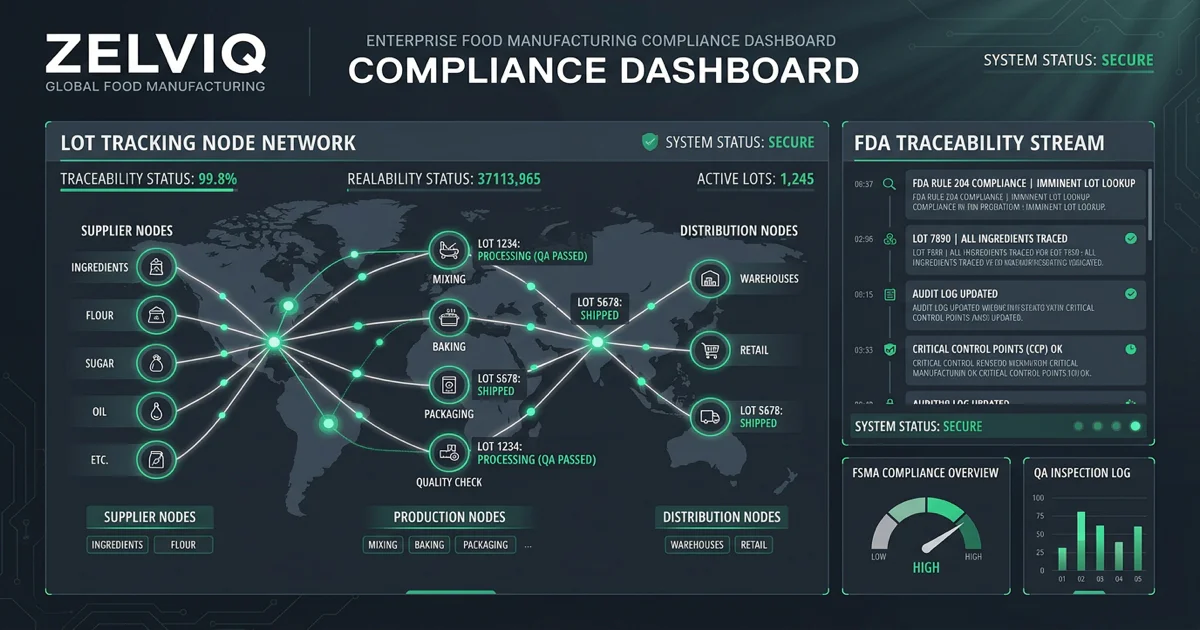
This is the approach a batch manufacturing system such as Zelviq takes. The trace is built as the work happens, so there is nothing to reconstruct when someone asks for it.
Found this article valuable?
Share it with your operational team and industry peers.