A leading cause of food recalls
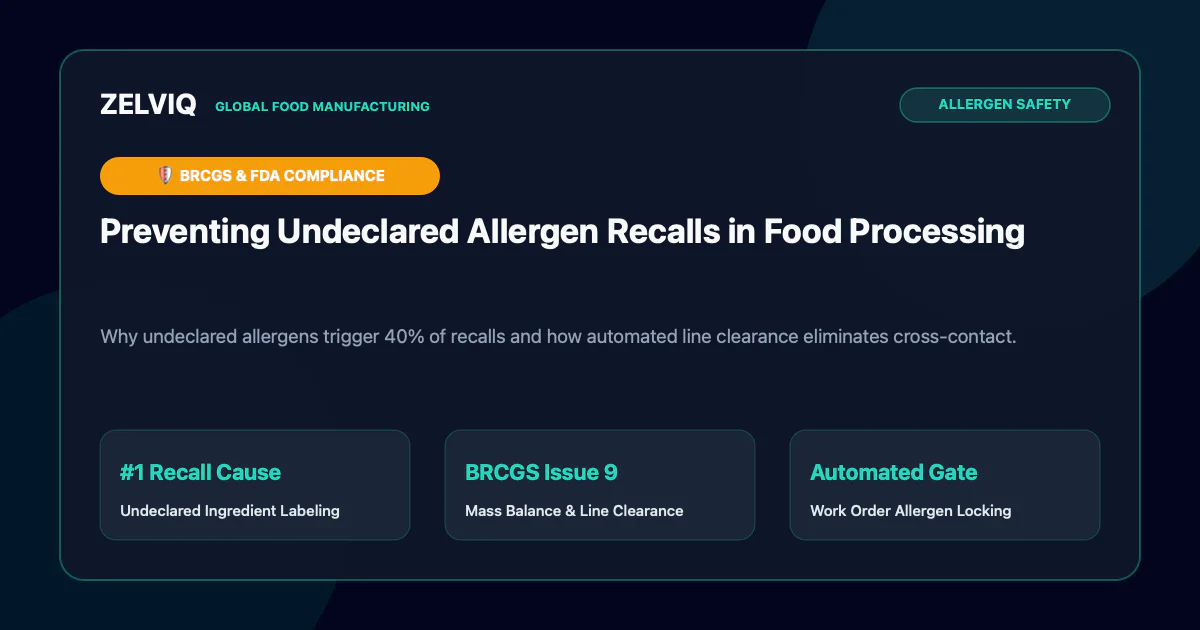
In both the US and the UK, undeclared allergens are consistently among the leading causes of food recalls. Unlike many microbial problems, which often begin at a farm or a supplier, most allergen recalls start inside the manufacturing facility, and they come from two operational failures: the wrong packaging or label, and allergen cross-contact at a changeover.
That makes them unusually preventable. The causes are well understood, they happen at predictable moments, and the controls that stop them are simple to describe. The difficulty is making those controls happen every time, on every shift.
Which allergens you must declare
The rules differ between markets, and a product sold in both has to satisfy both.
United States: 9 major food allergens. Under the Food Allergen Labeling and Consumer Protection Act (FALCPA), as amended by the FASTER Act, the major food allergens are milk, eggs, fish, crustacean shellfish, tree nuts, peanuts, wheat, soybeans and sesame. Sesame was added from January 1, 2023.
United Kingdom: 14 allergens. UK food law requires 14 allergens to be declared and emphasized in the ingredients list: celery, cereals containing gluten, crustaceans, eggs, fish, lupin, milk, molluscs, mustard, tree nuts, peanuts, sesame, soybeans, and sulphur dioxide and sulphites above 10 mg per kg or per litre.
A product can be correctly labeled for one market and non-compliant in the other. Celery, lupin, mustard, molluscs and sulphites must be declared in the UK, but are not among the US major allergens.
The two points of failure
1. The wrong packaging
The most common single cause of undeclared allergen recalls is also the simplest: the right product in the wrong package. A nut-containing variety is packed into film printed for a nut-free one, whose ingredient list does not mention nuts. It usually happens at a changeover, when packaging from the previous product is still at the line.
Recipe changes cause the same problem more quietly. A formula is updated to include an allergen, and packaging printed for the old recipe is used until the stock runs out.
2. Cross-contact at changeover
When a line moves from a product containing an allergen to one that does not, residue in hoppers, mixers, pumps, fillers and pipework can carry into the next batch. Dry lines are particularly difficult. Powders settle in places that are hard to reach, and dry cleaning is less thorough than a full wet wash.
Allergens that arrive with your ingredients
Not every undeclared allergen starts in your own plant. Ingredients can carry allergens their supplier did not declare, through shared equipment at the supplier's site, a change to the supplier's own recipe, or a substituted component. Spices, flavorings, seasonings and compound ingredients are where this most often hides, because they are made from components you never see.
Three controls reduce the risk:
- Ask at approval. Supplier approval should establish which allergens are handled on the same site and lines, and how they are controlled.
- Put it in the specification. Raw material specifications should list the allergens present and any cross-contact risk, and require the supplier to tell you before anything changes.
- Treat change as a new assessment. A new supplier, a new grade or a reformulated ingredient needs a fresh allergen review. It is not just a purchasing detail.
Verifying that cleaning removed the allergen
This is where many allergen programs have a blind spot. A visual inspection and an ATP swab confirm that a surface is generally clean, but ATP tests detect organic residue, not allergen proteins. A surface can pass an ATP test and still carry enough allergen to cause a reaction.
Allergen cleaning needs allergen-specific checks: protein swabs, or lateral flow tests for the particular allergen being removed. They serve two purposes. Validation proves a cleaning procedure works when it is first set up. Verification confirms it was carried out properly on each occasion. A validated procedure that is never verified is only as reliable as the last person who performed it.
What the standards require
FDA, 21 CFR Part 117. Where allergens are a hazard that requires a preventive control, the preventive controls rule requires food allergen controls covering both cross-contact during production and correct labeling, supported by monitoring and verification records.
BRCGS Global Standard for Food Safety. The allergen management clause, section 5.3, requires a documented assessment of allergen risk, segregation of allergenic materials, validated cleaning procedures between products, and label and packaging checks at changeover.
UK Food Standards Agency. Its guidance expects businesses to manage cross-contact risk through their controls, and to use precautionary "may contain" labeling only where a real risk remains after those controls, not as a substitute for them.
When an allergen incident happens
If a packaging mix-up or a cross-contact is discovered, the questions are the same as in any recall: which lots are affected, and where did they go?
Line clearance and packaging records decide how narrow the answer can be. If every changeover is recorded with its time, the packaging loaded and the verification result, the affected product is limited to the run between the last good check and the failure. Without those records, the only defensible answer is every lot the line produced until the problem was noticed, which can mean days of production and every customer who received it.
Controls that stop allergen recalls
The plants with the best allergen records do not rely on people remembering. They build each check into the moment its risk occurs:
- Check packaging against the order before the line starts. Scanning the barcode on the film roll or label stock against the product on the work order catches a packaging mix-up before a single pack is filled. Repeating the check at every roll change catches a mix-up mid-run.
- Clear the previous product's packaging at changeover. Line clearance should include physically removing every roll, label and carton from the previous run, with a signed check before the next product starts.
- Sequence production. Running allergen-free products before allergen-containing ones on a shared line reduces the number of full cleans needed and limits the risk when a clean is imperfect.
- Make the clean a gate, not a form. The next work order should not be able to start until the cleaning checklist and the allergen verification result are recorded against the line.
- Segregate allergenic materials in storage and at staging. Dedicated locations and clear identification reduce the chance of the wrong ingredient being picked.
- Change recipes and packaging together. When a formula changes, the old packaging should be blocked from use, so it cannot be used up "until it runs out".
When these checks are part of the production record rather than separate paperwork, every batch carries its own evidence: which packaging was used, which clean came before it, and what the verification showed. That record is what an auditor asks to see, and it is what stops the recall from happening in the first place.
Found this article valuable?
Share it with your operational team and industry peers.