In food and beverage manufacturing, few pathogens present as persistent a threat to operations and brand survival as Listeria monocytogenes. Unlike E. coli or Salmonella, Listeria thrives in refrigerated environments, forming resilient biofilms on stainless steel equipment, drain lines, and cold-room storage racks.
When a raw material lot or finished batch tests positive for Listeria, time is the single most critical factor. Delays in identifying affected lots or executing inventory holds can transform a localized containment event into a multi-state recall involving millions of units, regulatory consent decrees, and irreparable brand damage.
In this article, we analyze recent industry outbreak patterns, explore why legacy FIFO (First In, First Out) inventory management exacerbates contamination risks, and detail how automated FEFO (First-Expired, First-Out) stock rotation paired with 1-click emergency lot quarantine protects food processors.
1. The Microbiology & Cold Chain Dilemma of Listeria
Listeria monocytogenes is a psychrotrophic bacterium, meaning it continues to replicate at standard refrigeration temperatures (34°F to 40°F / 1°C to 4°C). Listeria thrives in high-moisture production environments such as fresh produce washing, dairy pasteurization, ready-to-eat (RTE) meat processing, and craft juice pressing. There it colonizes micro-fissures in conveyors, seals, and floor drains.
+-----------------------------------------------------------------------------+
|                        LISTERIA CONTAMINATION CASCADE                       |
+-----------------------------------------------------------------------------+
|  [Raw Material Receipt]  -->  [Cold Storage Storage]  -->  [Batch Mixing]   |
|   (Unchecked Expiry/Lot)      (Pathogen Replication)       (Cross-Lot Blend)|
+-----------------------------------------------------------------------------+
                                       |
                                       v
+-----------------------------------------------------------------------------+
|  [Finished Goods Shipping]  --> [Multi-State Retail] -->  [Mass Recall]     |
|   (Passive FIFO Picking)        (Consumer Exposure)       (Severe Liability)|
+-----------------------------------------------------------------------------+
Key Operational Risks:
- Extended Incubation Period: Symptoms can manifest 1 to 70 days after ingestion, meaning contaminated products may circulate in retail channels for weeks before an outbreak is linked back to a production facility.
- Cross-Lot Contamination During Batching: If a raw ingredient lot sits in cold storage beyond its optimal freshness window, microbial loads increase exponentially. When blended into multi-lot work orders, a single aging lot compromises every batch produced on that shift.
2. Why FIFO Fails in Perishable Inventory Rotation
Many food plants still rely on standard FIFO (First In, First Out) picking protocols. Under FIFO, operators pick inventory based on the date it arrived at the dock. However, in modern food supply chains, arrival dates do not correlate with expiration dates.
The FIFO Deficit Scenario:
- Lot A (Strawberries): Received Sept 1, Expires Sept 15 (14-day shelf life).
- Lot B (Strawberries): Received Sept 3, Expires Sept 10 (7-day shelf life due to transit delay).
Under FIFO, an operator picks Lot A first because it arrived two days earlier. Meanwhile, Lot B sits in cold storage, exceeding its shelf life, deteriorating in quality, and creating an ideal harbinger for microbial proliferation.
3. Automated FEFO: The Expiry-Driven Defense
FEFO (First-Expired, First-Out) revolutionizes lot management by dynamically picking inventory based on absolute expiration dates rather than dock receipt timestamps.
How Automated FEFO Enforces Quality Control:
- Dynamic Lot Selection: When a Work Order or Sales Order is generated, the ERP automatically allocates lots with the nearest expiration date that satisfy quality tolerances.
- Preventing Cold Storage Stagnation: Raw materials are consumed before microbial risks compound, drastically reducing scrap rates and ingredient degradation.
- Retail Customer Shelf-Life Compliance: Major retailers require a Guaranteed Remaining Shelf Life (GRSL). A typical threshold is at least 70% of shelf life remaining upon delivery. FEFO algorithms enforce account-specific GRSL constraints automatically.
4. 1-Click Emergency Lot Quarantine & Traceability
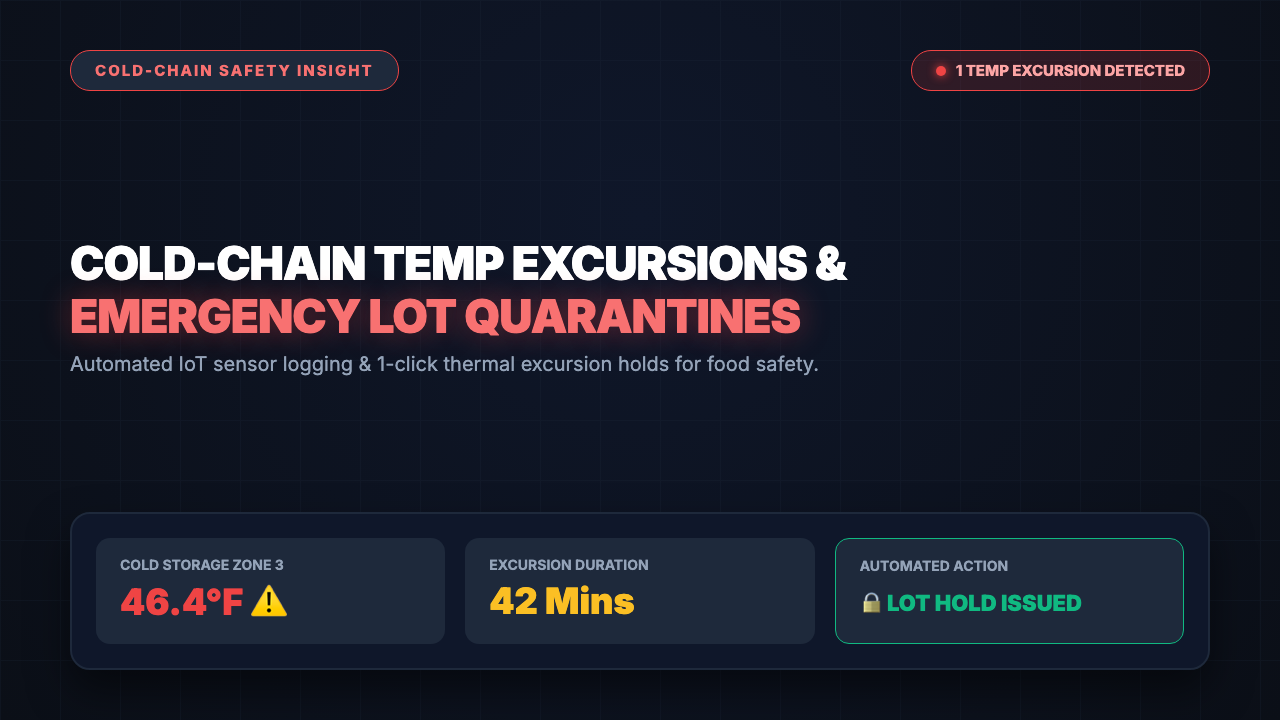
When an environmental swab or finished product sample returns a presumptive positive for Listeria, QA managers cannot afford hours spent pulling paper binder logs or querying legacy accounting tables.
+-----------------------------------------------------------------------------+
|                     1-CLICK EMERGENCY LOT QUARANTINE                        |
+-----------------------------------------------------------------------------+
| Target Lot: #LOT-2026-RAW-8849                                              |
| Action: EMERGENCY LOCK & QUARANTINE                                         |
+-----------------------------------------------------------------------------+
|  [x] Locked in Raw Inventory (Warehouse A, Cold Bay 3)                      |
|  [x] Blocked from Active Work Orders (WO #4920, WO #4921)                    |
|  [x] Quarantined in WIP & Finished Goods (Pallet #9901 .. #9914)             |
|  [x] Flagged on Shipped Sales Orders (SO #10294 -> Retail Customer B)        |
+-----------------------------------------------------------------------------+
Instant Lockout Protocol:
- Instant Warehouse Quarantine: Placing a raw material lot code on quarantine status instantly freezes every location holding that lot. Warehouse operators scanning barcodes receive immediate visual and audio lockout warnings on mobile scanners.
- WIP & Work Order Interruption: Active production lines consuming the affected lot are flagged, preventing further batch conversion.
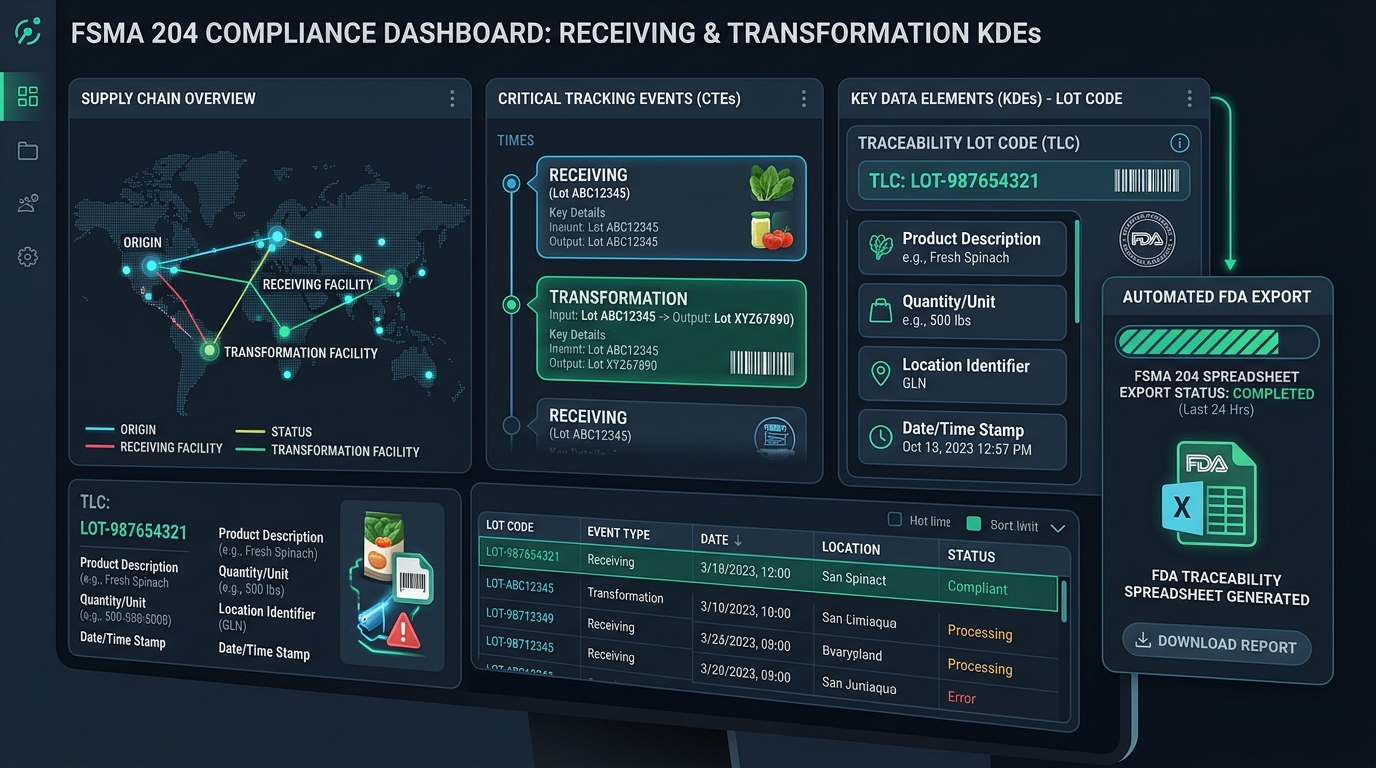
- Bidirectional Trace Genealogy: In under 2 seconds, Zelviq constructs the complete tree: Vendor PO -> Raw Lot Code -> WIP Batch -> Finished Goods Lot -> Customer Sales Orders & Delivery Manifests.
5. Audit Preparedness & Compliance Checklist
To ensure your plant stands ready for FDA FSMA 204 audits and SQF/BRCGS inspections:
- Digitize Lot Receiving: Capture supplier lot code, internal lot code, manufacture date, and expiration date at the receiving dock.
- Enforce FEFO Picking Rules: Eliminate manual operator lot selection on the shop floor.
- Automate Temperature Monitoring Integration: Link storage location logs directly to lot records for complete environmental chain-of-custody.
- Conduct Quarterly Mock Recalls: Verify your team can generate a complete bidirectional trace report and customer contact notification list in under 5 minutes.
Summary
Listeria control requires proactive hygiene, continuous environmental monitoring, and modern ERP infrastructure. By combining FEFO stock rotation with instant automated lot quarantine, food manufacturers protect public health, eliminate ingredient waste, and ensure audit compliance.
Found this article valuable?
Share it with your operational team and industry peers.