Under Global Food Safety Initiative (GFSI) standards such as SQF (Edition 9), BRCGS (Issue 9), and FSSC 22000, food processing facilities must conduct at least one annual Mock Recall exercise.
During an unannounced audit, an auditor will select a random raw material lot or finished product SKU and demand full forward and backward lot lineage records within 2 hours.
Manual paper binders and fragmented spreadsheets often fail under this time pressure, resulting in failed audit points or non-conformance notices.
In this guide, we break down the step-by-step framework for executing a flawless 2-hour mock recall.
1. Step-by-Step 2-Hour Mock Recall Framework
A successful mock recall follows five synchronized operational steps:
Step 1: Scenario Trigger & Timer Start (T + 0:00)
The recall coordinator selects a specific lot number (e.g. Organic Oat Flour Lot #OAT-2026-0814) and initiates the clock.
Step 2: Backward Lot Tracing (T + 0:20)
Locate the receiving Purchase Order, supplier Certificate of Analysis (CoA), date received, quantity received, and warehouse storage bins.
Step 3: Forward Usage & Batch Lineage (T + 0:45)
Identify every Work Order batch where the raw material lot was consumed:
- Work Order #WO-4902: 450 lbs consumed -> Produced 900 cases Finished Granola Lot #FG-9021
- Work Order #WO-4911: 300 lbs consumed -> Produced 600 cases Finished Granola Lot #FG-9022
- Remaining Warehouse Stock: 250 lbs on Hand
Step 4: Distribution & Customer Identification (T + 1:15)
Query Sales Orders and Bills of Lading to determine exactly which customer accounts received shipments of the impacted finished goods lots:
- Retail Customer A: 400 cases delivered (Invoice #INV-8810)
- Distributor B: 800 cases delivered (Invoice #INV-8814)
- Finished Goods Warehouse: 300 cases on Hand
Step 5: Material Balance Reconciliation & Audit Report (T + 1:50)
Calculate total mass balance reconciliation to ensure 100% accounting of all affected materials across receiving, production, and distribution.
2. Mock Recall Report Checklist
When submitting your mock recall packet to an FDA investigator or GFSI auditor, include:
- Exercise Timeline Log: Exact timestamps from scenario initiation to final report generation.
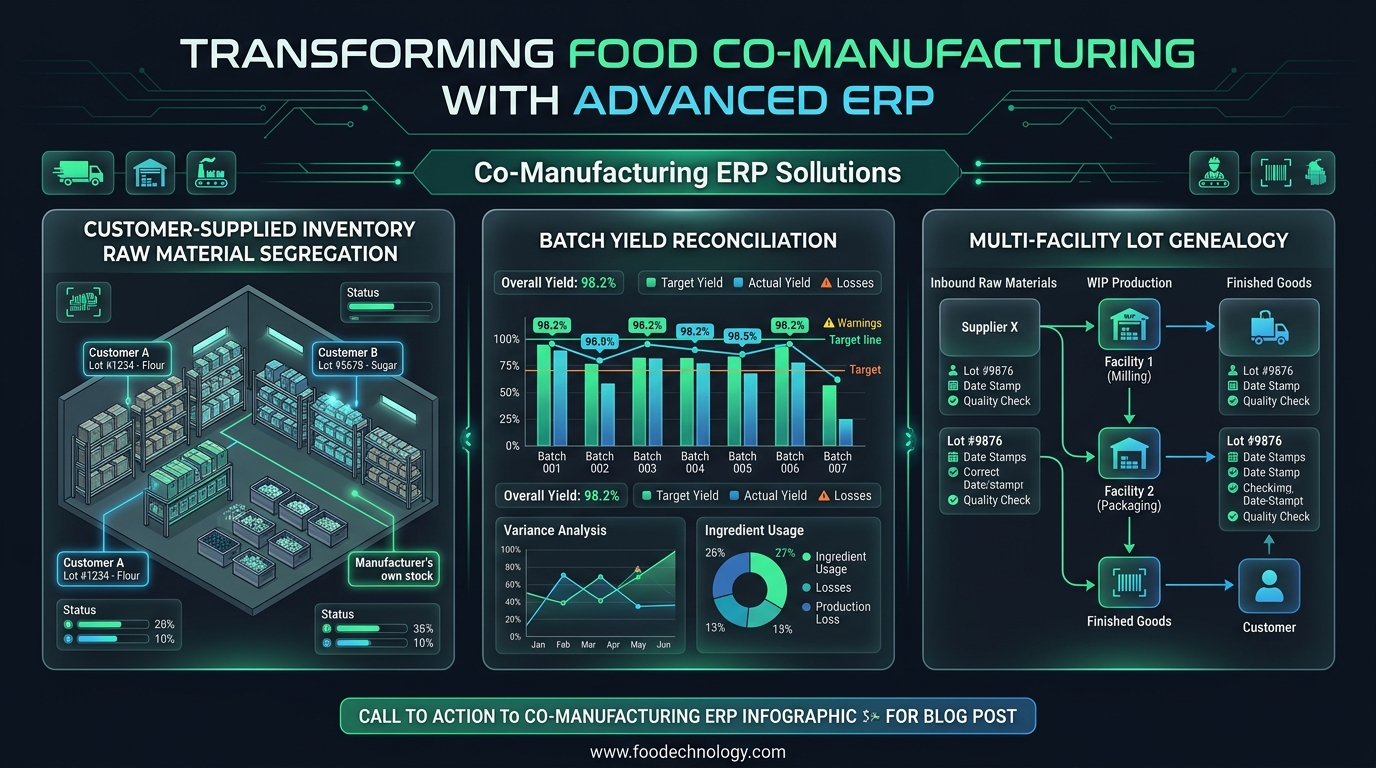
- Traceability Tree Diagram: Visual diagram mapping raw material supplier lot -> Work Order numbers -> Finished Product lots -> Customer Accounts.
- Mass Balance Reconciliation Table: Complete accounting of all units accounted for vs. missing.
- Corrective & Preventive Action (CAPA) Log: Documented identification of any delays or data gaps encountered during the test.
3. How Zelviq Automates Mock Recall Execution
⏱️ Execute 100% Traceable Mock Recalls in Under 15 Minutes
Eliminate frantic binder searches. Zelviq generates instant forward and backward lot lineage trees, customer contact manifests, and mass balance reconciliation reports in clicks.
👉 Explore Zelviq Traceability & Mock Recall Software | Book a Live Recall Demo
Conclusion
Mock recall readiness is the ultimate proof of plant floor operational control. By digitizing raw material receiving, work order consumption, and sales order shipments in an integrated cloud ERP, food manufacturers turn stress-filled 2-hour audit drills into effortless 15-minute verification exercises.
Found this article valuable?
Share it with your operational team and industry peers.