The relationship between food brand owners and contract manufacturers (co-packers) is essential for scaling production. However, co-manufacturing introduces unique operational challenges that standard accounting software cannot handle.
When a brand supplies proprietary ingredients or custom packaging to a co-packer, both parties require complete transparency into inventory ownership, batch yields, and lot traceability.
Without dedicated co-manufacturing ERP workflows, disputes over material scrap rates, missing lot numbers, and inaccurate tolling invoices threaten key commercial partnerships.
In this guide, we explore how co-packers and brand owners streamline contract production.
1. Key Challenges in Co-Manufacturing & Co-Packing
A. Customer-Supplied Inventory Segregation
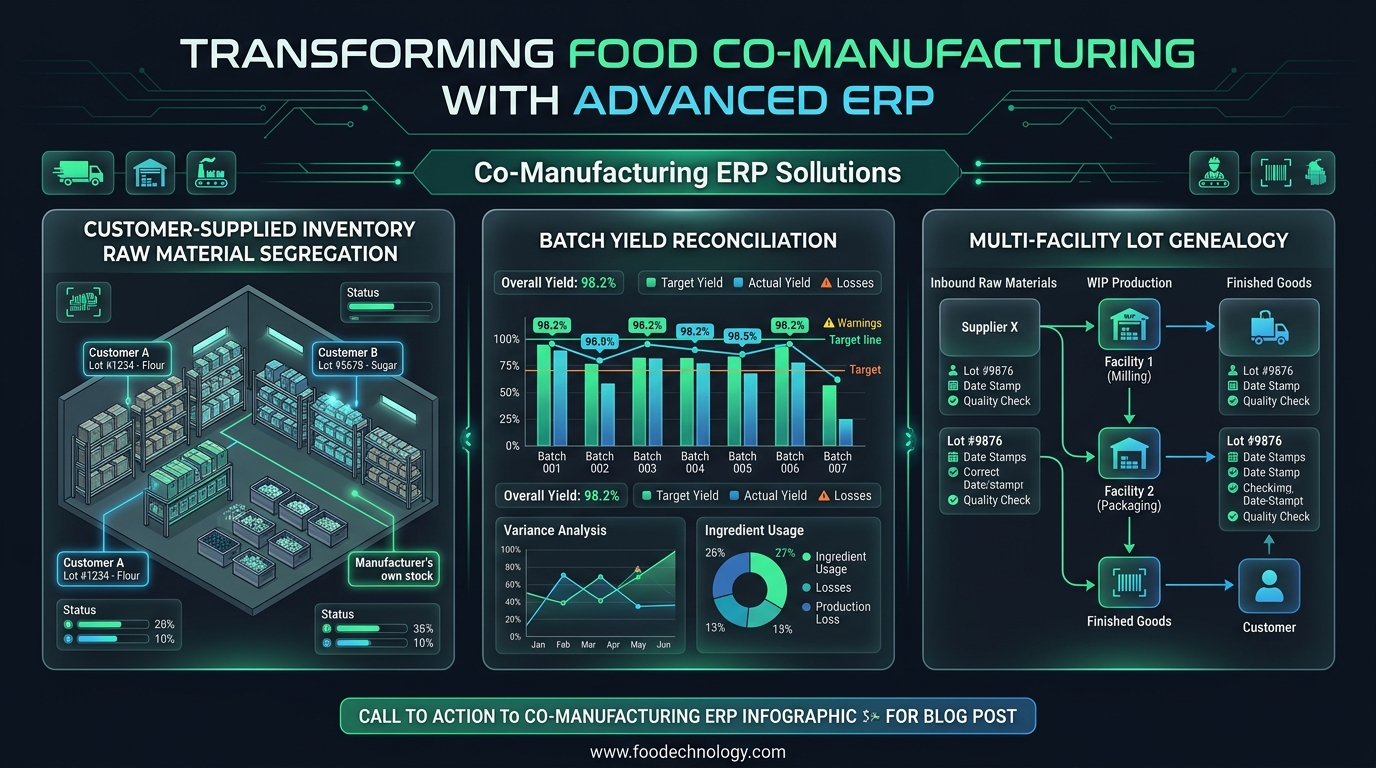
Co-packers frequently hold raw materials owned by multiple brand clients in the same warehouse. Mixing up customer-supplied ingredients or allocating Client A's organic sweetener to Client B's production run leads to financial liability and breach of contract.
B. Toll Manufacturing Batch Yield Reconciliation
In toll manufacturing, the brand owner expects a precise finished goods yield from the raw materials supplied. If a batch yields 4% less finished goods than theoretical targets due to line loss or spillages, clear ERP tracking is required to determine whether scrap fell within agreed tolerance thresholds.
C. Multi-Facility Lot Genealogy & Quality Release
Brand owners must ensure that every batch packaged by a co-packer meets strict quality control standards and Certificate of Analysis (CoA) specifications before authorizing warehouse release.
2. Best Practices for Co-Packers & Brand Owners
- Segregated ERP Stock Bins: Tag all customer-provided inventory with dedicated Customer Account IDs so pick algorithms exclude customer stock from general availability.
- Standardized Bill of Materials (BOM) & Scrap Factors: Define contractual target yields and allowable scrap percentages directly in the ERP work order master.
- Automated Batch COGS & Tolling Fee Billing: Calculate total batch cost by combining customer-supplied material valuation with co-packer tolling labor and overhead fees automatically.
3. How Zelviq Simplifies Co-Manufacturing
🏭 Seamless Co-Packer Inventory & Batch Yield Control
Manage customer-supplied inventory, track multi-facility lot genealogy, and reconcile tolling batch yields effortlessly in Zelviq.
👉 Explore Zelviq Co-Manufacturing ERP Solution | Book a Co-Packing ERP Demo
Conclusion
Successful co-manufacturing relies on real-time data visibility. By implementing an ERP platform designed for customer-supplied inventory, co-packers protect client trust, eliminate billing disputes, and execute audit-ready batch production with confidence.
Found this article valuable?
Share it with your operational team and industry peers.